 +91 9131509957
 info@rishikulyogshala.org




Solar Plexus Chakra: What It Does, Where It Is, and How to Balance It?
Solar Plexus – just by hearing its name, you know instinctively that it is connected to the sun’s energy. Warm, bright, and full of life, the solar plexus chakra embodies this same fiery strength. It is responsible for controlling your drive, willpower, and confidence.
Our body contains seven major chakras, each representing an energy centre that governs various aspects of our physical, mental, and emotional well-being. The Solar Plexus is the third chakra, located at the centre of the body, illuminating our personal power.
Like the sun lights up the world, a healthy Solar Plexus brings light to your inner world —giving you strength and motivation, and filling you with purpose and goals. When this chakra is functioning well and aligned with your body, it seems like everything in your mind is clearer. Your head is clear, your movement has a purpose, and you exhale the deep breaths of determination—perhaps even of courage.
In this blog, we’ll look into what the solar plexus chakra is, how it influences our emotions and outlook on life, and some simple ways we can look after and balance this vibrant powerhouse of our bodies.

What is Solar Plexus?
The Solar Plexus is a network of nerves in the centre of your body, just above your navel. It’s an important centre that helps regulate many functions “downstream” in your stomach area, like digestion and how your body responds to stress.
It is also known as the Coeliac (belly) Plexus, and it was given the name Solar Plexus because its arrangement resembles a sun with rays spreading out in different directions.
In Sanskrit, it is called Manipura, or “city of jewels.” The Solar Plexus is the third chakra in energy systems. It also represents your confidence, willpower, self-esteem, and inner strength. When it is in balance, you feel empowered, driven, and capable of facing life’s challenges.

Where Is The Solar Plexus Located In The Human Body?
The Celiac plexus (also known as the Solar Plexus) is a tangled network of parasympathetic and sympathetic nerves in the abdomen, situated behind the stomach and in front of the area of crura near the celiac artery crossing over the diaphragm. The actual spot is just above where the major arteries branch off the abdominal aorta, including the celiac trunk and the superior mesenteric artery.
It corresponds to the third chakra, located just below your sternum. By regularly practising Solar Plexus chakra meditation, you can envision it as a radiant power centre that governs your confidence and willpower.
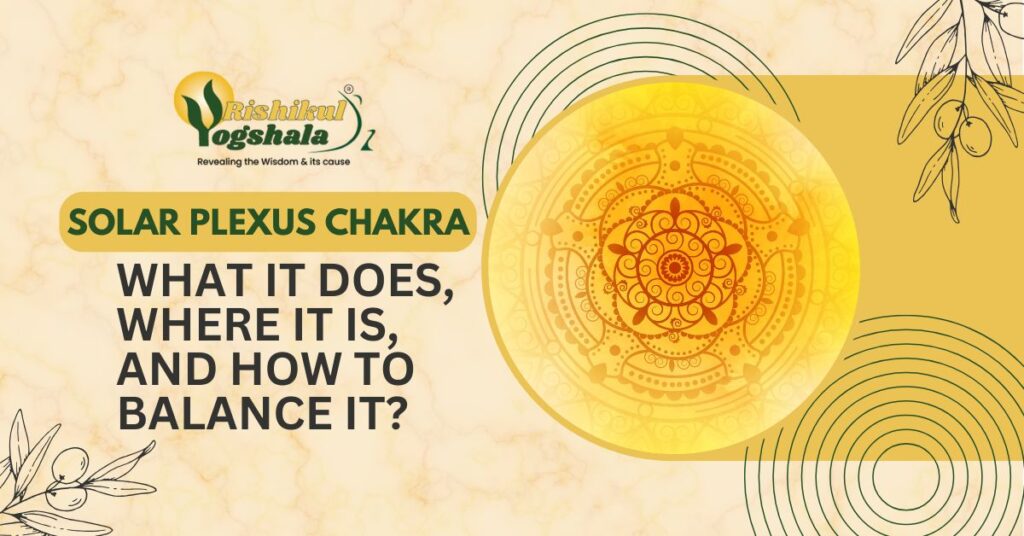
This chakra is yellow in colour and can change to a radiant golden yellow as your energy and awareness expand. Its sign is a circle with 10 petals and a downward triangle. The fire of energy, transformation and power – this is the element of this chakra. The Solar Plexus chakra is crucial, as it drives you on in life, keeps you focused on your ambitions, and helps you follow your dreams. Many of the body organs in your abdomen receive their supply of nerves and impulses (or autonomic innervation) from the solar plexus.
These organs include:
- The first two-thirds of the large bowel
- Gallbladder
- Kidneys
- Liver
- Pancreas
- Small bowel (duodenum, jejunum, ileum)
- Spleen
- Stomach

What Does The Solar Plexus Do, and What Is It Responsible For?
The Solar Plexus is an important part of your body’s nervous system, ensuring that all your internal organs are functioning just as they should. It controls digestion and metabolism—especially during times of stress. This network is made up of nerves from both the sympathetic and parasympathetic nervous systems. Under stress, the sympathetic system can slow digestion and other body functions as part of the “fight-or-flight” response, during which blood refocuses on the brain and muscles.
Then the parasympathetic system, guided by the vagus nerve that connects your brain to your stomach, becomes active again, helping your body return to normal digestion and efficiently absorb nutrients from your food. The “gut brain,” made up of nerve cells in your stomach, also plays an important role by helping regulate and manage digestion.
Spiritually and energetically, the Solar Plexus plays a key role in shaping a person’s emotional well-being and spiritual growth:
- Self-Esteem: Bringing light into the Solar Plexus enables us to remember that we have everything we need within us and to understand that we can be in charge of our lives.
- Willpower: This centre of power amplifies our sense of discipline and persistence, enabling us to concentrate on the task and goal at present.
- Self-Growth: Rebalancing the Solar Plexus makes us feel good about ourselves, appreciate our own self-worth, and love and accept who we are.
- Inner Power: When this chakra is balanced, we have faith in ourselves and are courageous to make choices for our own lives.
- Trust: The Solar Plexus powers our self-trust in skills, instincts, and judgment, infusing confidence in our decisions.
- Digestion & Metabolism: The Benefits of this chakra are not limited to the spiritual; your physical energy and digestive system health are also influenced, as it supports the body’s capacity to process nutrients, maintains energy levels, and strengthens your inner strength.
It is with these physical and energetic respects combined that the solar plexus becomes a nerve-centre for charisma, beauty, motivation, freedom, strength, and self-determination.
Read More: Ujjayi Pranayama: Steps, Benefits & How to Practice
What Does It Mean When You Have Pain In Solar Plexus Muscles?
Pain in and around your solar plexus can range from mild to severe, stabbing, burning, or gripping pain that you feel in the middle of your abdomen. This patch of tissue is a complex network of nerves that interacts with lots of important organs – including the stomach, liver, pancreas and intestines. If these nerves or organs are subjected to tension, irritation, or inflammation, it can present as pain in the pelvic floor.
- Torn Muscles: Using abdominal muscles quickly or a lot, poor posture, heavy object lifting and intense gym sessions can result in torn or pulled muscles around the solar plexus, resulting in sharp, stabbing-like pain through the upper-middle stomach.
- Trauma/Injury: If the upper stomach is impacted (by an elbow, someone’s foot, or even just having the wind knocked out of you), you may momentarily stun or paralyze your diaphragm, and sudden sharp pain can occur in the solar plexus area.
- Pancreatic Problems: Diseases such as pancreatitis or, in rare cases, tumors of the pancreas can also cause persistent pain in the solar plexus. Swelling in the pancreas or growths in the organ, for example, can press on nearby nerves and obstruct parts of the digestive system.
- Digestive issues: If you experience acid indigestion, gastritis, or acid reflux, then these might cause the nerves in the solar plexus region to become irritated and result in a burning or gnawing sensation in the upper abdomen.
- Gallbladder and Liver Problems: Gallstones, infections or inflammation of the liver or gallbladder can cause sharp, cramping pain in the area of the solar plexus that may also spread to your back or below your right shoulder blade.
- Stress and Emotional Tension: We have all heard the expression that stress “affects us at our gut level.” Mental or emotional tension could literally appear as a contraction or sensation of pressure in the solar plexus, because it is so strongly connected to nervous responses and muscular contractions.
Pain in the solar plexus can range from mild to severe, depending on the cause. If you have severe or constant pain, it is essential to seek medical attention as soon as possible to assess your injury.

How To Identify A Blocked Third Chakra (Solar Plexus)
Learning the signs of a blocked or unbalanced solar plexus chakra represents a first step in healing. When this chakra is imbalanced, it can negatively affect your health, body, emotions, and state of mind. By recognising these signals, you can rebalance and restore your own strength.
Physical Symptoms
The solar plexus chakra is closely related to digestion and the overall energy level throughout your system. When it is blocked, a number of physical symptoms can develop. Indigestion, heartburn, bloating, gas, constipation, diarrhea, IBS, ulcers, or general stomach discomfort.
- General Tiredness or Weakness: Constant tiredness throughout the day or a noticeable drop in the level of energy.
- Changes to Weight: Difficulty in maintaining a healthy weight or sudden weight gain/loss.
- Mood Symptoms: Given that self-esteem and personal power are at stake, we typically see emotional struggles when they are blocked.
- Low Self-Esteem: Feeling like you’re unworthy, inadequate, or not good enough.
- Lack of Confidence: Murmuring to yourself or thinking about yourself in ways you shouldn’t.
- Anxiety and Fear: Experiencing anxiety that is disproportionate or getting overwhelmed with fear.
- Weak Boundaries: It’s hard to say ‘no,’ to stand up for yourself, or to let others know what you need.
Mental Symptoms
An imbalanced Solar Plexus Chakra can make one feel clouded in mind when making decisions.
- Self-Doubt: Always full of uncertainty about yourself and your choices.
- Victim Mindset: Life is seen as something for you to suffer, and relationships are believed to be detrimental.
- Negative Self-Talk: Frequent bad-mouthing of oneself, internal voices telling you how awful you are, or just making you feel mentally polluted.
Yoga Postures That Energise and Harmonise The Solar Plexus Chakra
Yoga has long been known for its ability to activate and balance the seven chakras, the body’s key energy centres. Each chakra is associated with specific areas of the body and aspects of life, and particular yoga poses are especially effective for stimulating and harmonising each energy centre.
After careful research and practice, we have highlighted specific yoga poses for the solar plexus chakra that focus on the abdominal area, strengthen the core, and release tension. These poses not only help restore the natural flow of energy but also boost confidence, personal power, and willpower.
- The Warrior Postures (Virabhadrasanas I, II, III): All three poses will help to strengthen the body, boost confidence, and develop inner power.
- Boat Pose (Paripurna Navasana): Develops core strength and willpower.
- Surya Namaskar: Brings heat and energy to the whole body and unlocks the energy of the Solar Plexus.
- Triangle Pose (Trikonasana): Strengthens and stretches the core muscles, improving stability and balance.
- Ardha Matsyendrasana: Regular practice of this asana will stimulate the digestive organs and also release tension in the stomach.
- Cobra Pose (Bhujangasana): Opens the chest, strengthens the spine, and inspires self-confidence.
- Chair Pose (Utkatasana): Engages the legs and core, instilling strength and determination.
- Reverse Warrior: Calms the body and gives peace to the inner temple
- Camel Pose: Opens chest and abdomen, stimulating the solar plexus.
- Lion’s Breath: A breath method that releases stress and brings new energy into the body, rather like a quick pick-me-up coffee.
If you continue to perform these asanas with conscious breathing and meditation, you will be able to experience deep solar plexus healing, which helps enhance digestion, emotional stability, and self-esteem. Incorporating these into your practice enables you to access the power within—promoting vitality, mental clarity, and empowerment in your body.
Read More: Om Shanti Mantra: Meaning, History & Its Deep Connection With Yoga
Conclusion
Your solar plexus is the heart of inner power, confidence, and inner strength. When balanced, it fuels not just your body but also your mind and spirit, helping you face life with clarity and boost courage. Yoga, meditation, and mindful breathing are potent tools for awakening and energising this chakra. At Rishikul Yogshala in India, you can experience guided practices during our 200 Hour Yoga Teacher Training that strengthen your solar plexus, enhance your self-confidence, and bring harmony to your body and mind—transforming not just your practice, but your entire approach to life.

MEDITATION, INSPIRATIONAL AND SPIRITUAL GUIDE
Yogi Gangesha Chaitanya is a master of Yoga Philosophy, Meditation, Pranayama, and Spiritual Guidance, trained under Swami Rama and renowned institutions like the Himalayan Tradition and Sri Aurobindo Ashram. With expertise in Kundalini Yoga and meditation, he mentors students in 200-hour and 300-hour Yoga Teacher Training programs, guiding them toward inner awareness, spiritual growth, and a deeper understanding of yoga.
View Instagram Profile

- What Are Healing Frequencies? Understanding the Power of Sound and Vibration
- Solar Plexus Chakra: What It Does, Where It Is, and How to Balance It?
- Om Shanti Mantra: Meaning, History & Its Deep Connection With Yoga

- Ujjayi Pranayama: Steps, Benefits & How to Practice

- Is 200 Hour Yoga Teacher Training Course Enough to Build a Successful Teaching Career?